skip to main |
skip to sidebar
Acronyms! Love them or hate them? You know what I mean - those words formed from the initial letters of other words. You can go to www.acronymfinder.com and look up over 3,000,000 million of them.
Governments are really good at making them up so that they are pronouncible but carry no meaning other than identification: e.g.- NOFEAR (National Organisation for European American Rights)
- NATO (North Atlantic Treaty Organisation),
- CSIRO, pronounced 'sigh-row' (Commonwealth Scientific and Industrial Research Organisation),
- ASIO (Australian Security Intelligence Organisation),
- and apparently about 3,000,000 others.
Geez, I've even done it myself with BRFSStrategic - Big Red Flying Squirrel. You'd think I'd know better!
But consider when an acronym can become a useful metaphor full of meaning:-
NESST - National Executive Strategic Sustainability Team - the idea being that this top-level team was to be a nest to nurture various initiatives.
CAST - Change Agent Support Team - for a team responsible for implementing change, the acronym made it clear that the team members were the cast who were the main players in any effort, not just directing but actively participating.
NeWT - New World Training - for a training program designed to give participants awareness and tools to manage their own culture. Quite apt, because a newt is an animal capable of regenerating lost limbs.
What I found really fascinating was that the culture in each of these cases was 'robust' enough to tolerate some digs at these acronyms.
For example, one wag described NESST as a place for those who were feathering their own! CAST was quickly referred to in some quarters as CAST-AWAY. NeWT left some people wondering what parts needed regeneration.
These sort of meaningful acronyms tell a story of their own, and give people some way of judging when they are no longer apt acronyms but only anachronisms (sound pretty close don't they?), which could indicate it's time to change, give them up and do something else.
Do you have any favourite acronyms???
addendum 24/11/2006: there's a lovely post about acronmyms by John Maeda here.

Hugh Macleod, somewhere on his Gaping Void blog, has this neat cartoon depicting the company hierarchy. It's a pyramid, naturally enough, and at the base are 'losers', in the middle are 'clueless' and at the top are 'sociopaths'. Fair enough, even if it's not totally fair. Perhaps it's only 95% fair ;-). And while Hugh labels the bottom layer 'losers', it seems to me that in this particular pyramid, everyone is a loser.
Dave Pollard's post, Living on the Edge, presents a diagram of a series of concentric circles - the outermost circle which comprises 10% of the population are the innovators on the edge, and the innermost circle which comprises just 1% of the population are the political and business elite. I suppose that if you had a conical pyramid instead of the usual square and looked at it from a hot-air balloon :-) both Hugh's and Dave's drawings might look similar. Not that I equate Dave's edge-dwellers with Hugh's losers!
There's another connection, too. Both Hugh and Dave have described systems - very sick systems, full of wicked problems: and full of people, too, including some wicked ones no doubt.
Today a thought popped into my head - just what do most companies do that actually adds real meaning to people's lives? When I talk to business owners, and when I talk to employees, I'm often struck by the similarity of the conversations. The really serious conversations, which don't happen so often because they are so scary, all seem to lead to 'meaning' ... like, "What does all this activity really mean?" or "Well, now I've made it, it just doesn't seem to mean what I thought it would". And the same inquiries could be made not just by individuals but also by entire systems, however defined; a team, a company or even a country.
Somehow I know that it doesn't matter how much training you have or take, how many 'change management' initiatives you introduce, or how many workshops, focus groups, seminars or Open Spaces you invoke, nothing makes much lasting difference, nothing sticks, without 'meaning'. It's tricky because 'meaning' doesn't get decided - - - it sort of arises, and I have a hunch that it does so individually AND collectively almost simultaneously because we are relational beings. (If it doesn't arise, then it's basically imposed, which is the cause of the lament of so many business owners that their employees just don't seem to get it - of course they don't ... it literally means nothing to them.)
Practically, what does it mean, say, for a company? I'm of the view that most strategic activity is basically what could be called sense-making. The best analogy I've heard is that it's making sense of a game where no one has told you the rules or how many players there are and the rules and the players keep changing all the time! Which is also about wicked problems.
Sense-making is only a stepping stone to meaning. Lots of people tend to equate the two but I think there's a big difference. The best way I know how to explain the difference is through what my father told me about death: "We may comprehend death, but we will never understand it" - sense-making is aligned with comprehension, but meaning is about understanding.
What's more, there's no sense in your making sense all alone - you have to communicate it to others, both to be affected by them and their perspectives and to test the reality of your sense-making. In a company those others are what I call a 'strategic team'. Teams really are the greatest strategic asset you have in a company, but most so-called teams have quite a way to go before they perform in this way. It's more than a functional or operational arrangement, which is where most teams seem to be.
It's the situation where you realise that without the team and the other people on the team, your life would somehow have less meaning even if only because being part of the team brings out the best in you, work-wise and personally. Now that's a tough call for the company, for the team and for the individuals. It's also a choice that involves paying as much attention to the process of the team as to getting the job done.
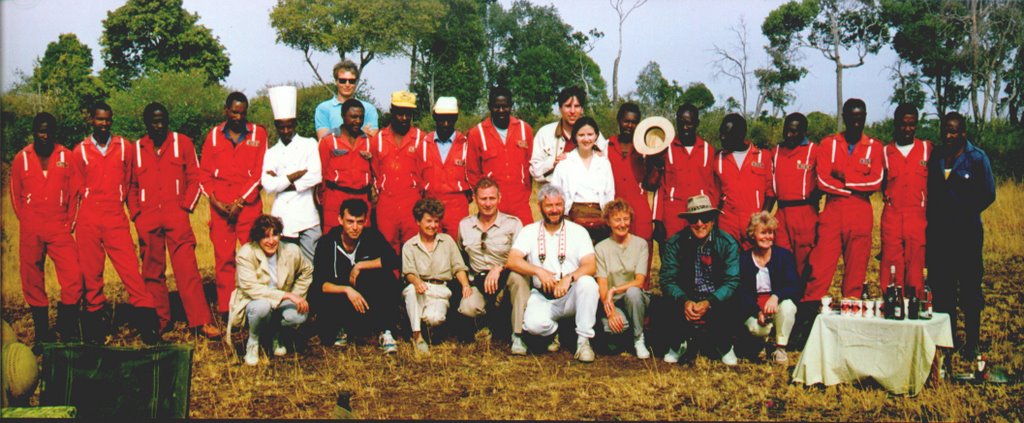
 In another life, I spent 4 years in Kenya. Every morning at daybreak, I'd pilot a hot-air balloon full of tourists over the Masai Mara game reserve. It was a fantastic time for me - I was doing something exciting in one of the most beautiful, diverse places on the planet.
Each morning a crew of 15 Kenyans would prepare the balloon and help at the launch. The passengers would pile into the wicker basket and off we'd float over the magnificent landscape, game-spotting from our lofty vantage point and usually landing near some hippo pools, where the crew would have already raced ahead and prepared a full breakfast.
For many passengers it was the highlight of their trip - perhaps even their lives! - sitting in the middle of the African savannah after an exhilarating flight, eating an English breakfast and drinking champagne. Most of the time they simply summed it up by saying, "Thank you for the best morning of my life!" Now that's job satisfaction.
But my job was easy, really: I was the 'bwana'. That's what the Kenyans often called me. It means a lot more than 'mister' and hopefully a lot less than 'master'.
Most of the time, I let the crew get on with their work as a team, interfering as little as possible. After all, they had seen plenty of pilots before me. They worked hard physically, to unpack and pack the balloon - all 350,000 cu.ft of it fully inflated - and prepare the tables and chairs for breakfast. Everything had to be loaded and unloaded onto the back of an ancient Bedford truck manually. And their pay wasn't great; certainly not compared to yours or mine.
Still, there was one guy, Gabriel, who never seemed to be doing much at all. Often seems to be the way with teams, doesn't it? I watched Gabriel for a few weeks and, by my judgement, he was certainly doing a lot less than the other guys on the crew. Not only that, he was always the first to have his breakfast which the crew did when the passengers had gone.
"This guy isn't pulling his weight," I fumed to myself, "because, after all, it's only fair that they all do the same amount of work, isn't it?" So, I resolved to talk to the crew chief, a man named Makalla, to tell him to get his act into gear, talk to Gabriel and get him to pull his weight.
Makalla came to see me and I launched into a lengthy explanation, which seems to be the way to make your point in Africa. Makalla nodded and nodded while I was talking, and the more I talked the more I agreed with my own point of view. "This is great - I'm getting somewhere," I noted to myself as I continued lecturing about team dynamics, leadership, equality and fairness. "Maybe I can make a difference here, be a leader.",
When I finished, Makalla simply looked at me and said, "But bwana Alex, we are not all the same."
I deflated, depressed. I wondered if they would ever get the point.A couple of weeks later, I got the point.
It was a windy dawn. The burners were roaring hot air into the balloon when the tether rope slipped and I was dragged under the basket for about 50 metres as the balloon was being pushed along by the wind. I had managed to turn off the burners and pilot light but was struggling to pull the rip-line which would open the top of the balloon and deflate it.Then I heard Gabriel shout - "bwana Alex! bwana Alex!", saw him running, and next, risk reaching in to grab the rip-line, very likely saving me from serious injury.
How many of our organizational teams are as adept at dealing with diversity as my African team?
How many of our organizational leaders really can accept that we are not all the same?
How many of our organizational leaders can create environments where even the different can shine?